2026.03.11
【Graduate School of Economics】PBL Field Trip to Maniwa, Okayama, July, 2025

Maniwa, Okayama Prefecture — a city surrounded by beautiful forests and mountains.
One of the strengths of the Ryukoku University Master’s Program in Economics is that it offers various opportunities for hands-on Project/Problem-Based Learning (PBL).
In July, 2025, a group of students—including international students such as Japanese government–sponsored students from Cuba and Laos, as well as Japanese students—participated in a field study on innovative wood manufacturing and forest resource management practices in Japan. Through this program, the students explored both private-sector initiatives and local government policies related to the forestry industry.
After World War II, large numbers of cedar trees were planted across Japan by local communities in order to address the shortage of timber for housing construction. Today, these trees are more than 60 years old and cover large areas of Japan’s mountainous regions. However, much of this timber remains underutilized. As Japan’s economy grew, domestic timber gradually lost its competitiveness against cheaper imported wood. As a result, vast areas of cedar forests have been left unmanaged, leading to the deterioration of forest ecosystems and increasing concerns about forest degradation.

A planted cedar forest in Maniwa
To address this issue, the Japanese government has introduced policies to promote the development of new products using these underutilized timber resources and to encourage their export overseas. One product expected to play a key role in this effort is CLT (Cross-Laminated Timber).
As part of this year’s PBL project, the students visited Maniwa City in Okayama Prefecture, where they learned about Japan’s largest CLT manufacturer and the local government’s efforts to develop infrastructure that fully utilizes local timber resources in collaboration with private companies. Maniwa City, located about 300 kilometers west of Kyoto, where Ryukoku University is based, is one of Japan’s leading forestry regions.
CLT is a wood-based construction material made by layering wooden panels with their fibers arranged perpendicular to one another, which significantly increases structural strength. In fact, CLT can achieve strength levels comparable to or even exceeding those of concrete in certain applications. The use of CLT enables the construction of mid- to high-rise buildings—up to around 20 stories—using primarily wooden materials. In Europe, CLT has already become widely used as a sustainable alternative to concrete in building construction.

A monument made of CLT (Cross-Laminated Timber)
On the first day of the field trip, after a three-hour journey to Maniwa, the students walked through locally planted forests to observe the forestry environment firsthand. They then visited a modern complex of buildings constructed using CLT, where they were able to see practical examples of this innovative material in architecture.
On the following day, the group visited Meiken Kogyo, a leading CLT manufacturer. The students toured the company’s state-of-the-art CLT mass-production facility as well as its biomass power plant. During the visit, the company’s president, Mr. Nakajima, gave a detailed presentation on the firm’s investment strategies, technological development, marketing priorities, and international business strategies, including approaches to overseas markets and pricing.

Tour of a biomass power plant of Meiken Kogyo

Students posing with President Nakajima and his staff members of Meiken Kogyo
The students also had the opportunity to hear from the Mayor of Maniwa City, Mr. Ota, who provided an overview of the city’s policies aimed at industrial transformation in the forestry sector. In particular, he explained the city’s comprehensive approach to “fully utilizing every tree in the region,” which includes infrastructure development and institutional reforms related to property rights among small-scale forest landowners.

Meeting with Mayor Ota of Maniwa City
One of the main objectives of this field study was to allow students to experience the realities of business and public policy while learning about the challenges and innovations introduced by various local stakeholders. Maniwa City is considered relatively advanced within Japan in terms of forest resource management and forestry-related industrial reform. Nevertheless, even here, the systems for effectively utilizing the large volume of unused timber in the mountains remain insufficient.
Through this experience, the students came to recognize that developing overseas markets for timber products and improving the productivity of local forest resources will be crucial for strengthening international competitiveness. With these insights, the group returned to Kyoto with new ideas and perspectives for further study.
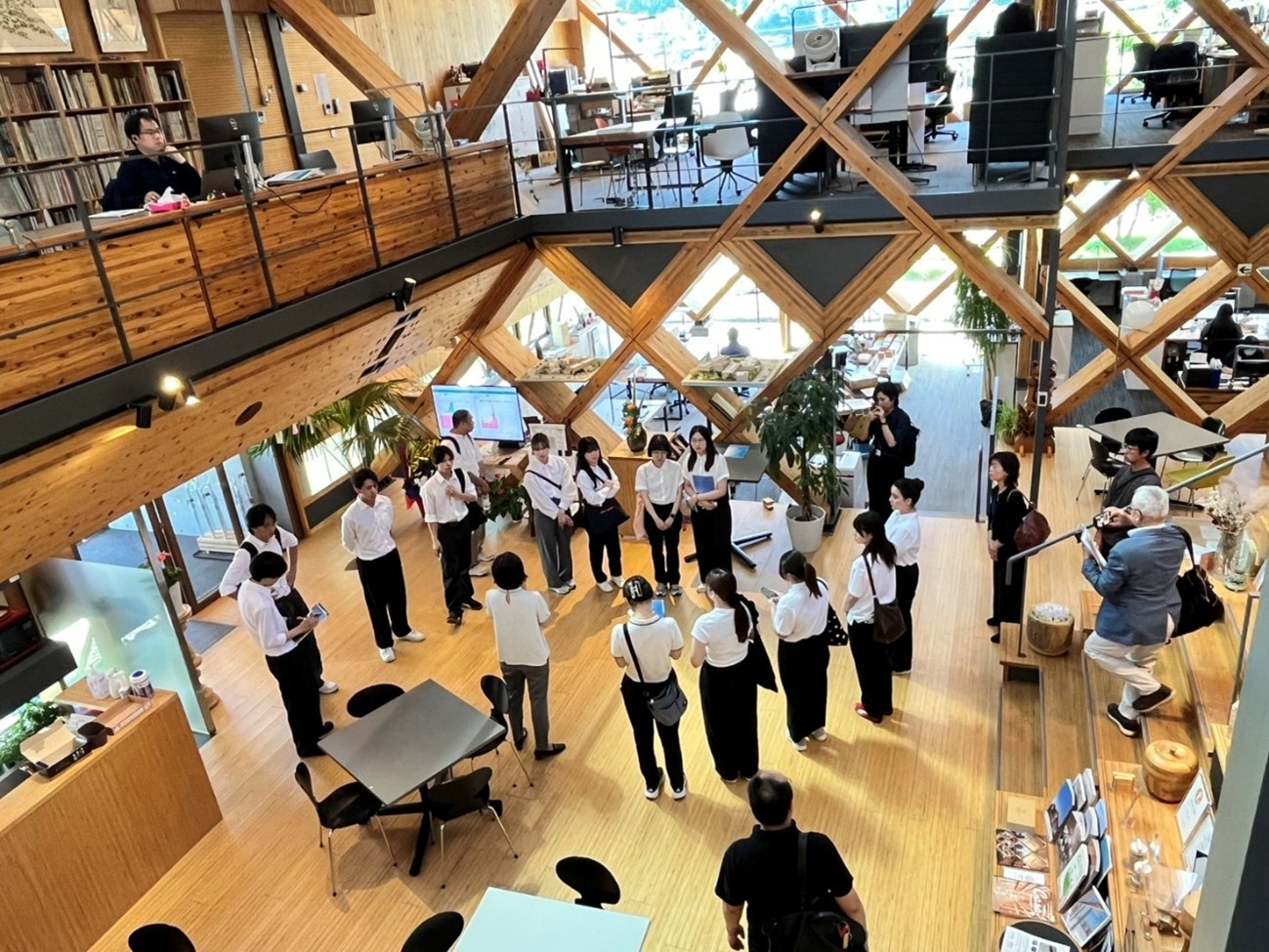
Discussion at Meiken Kogyo’s CLT-built headquarters