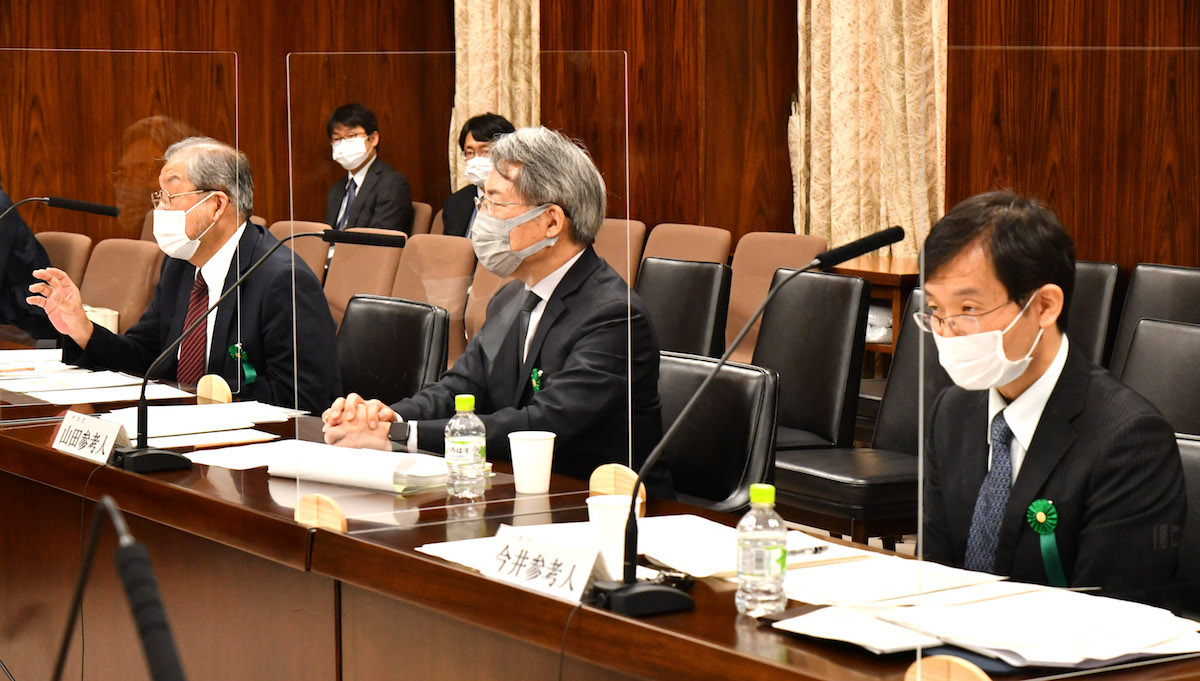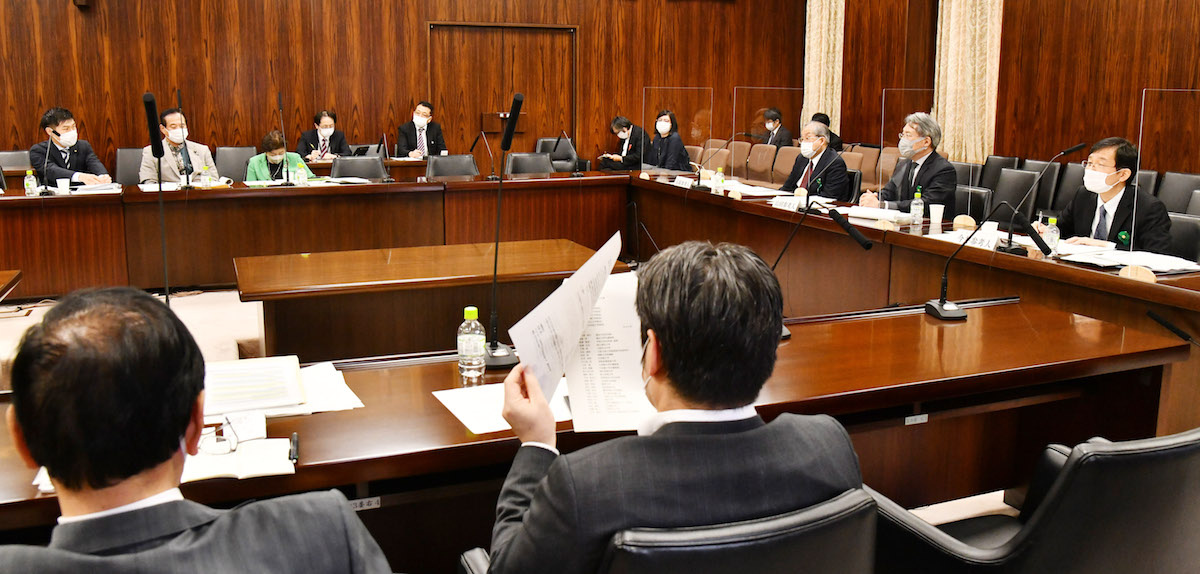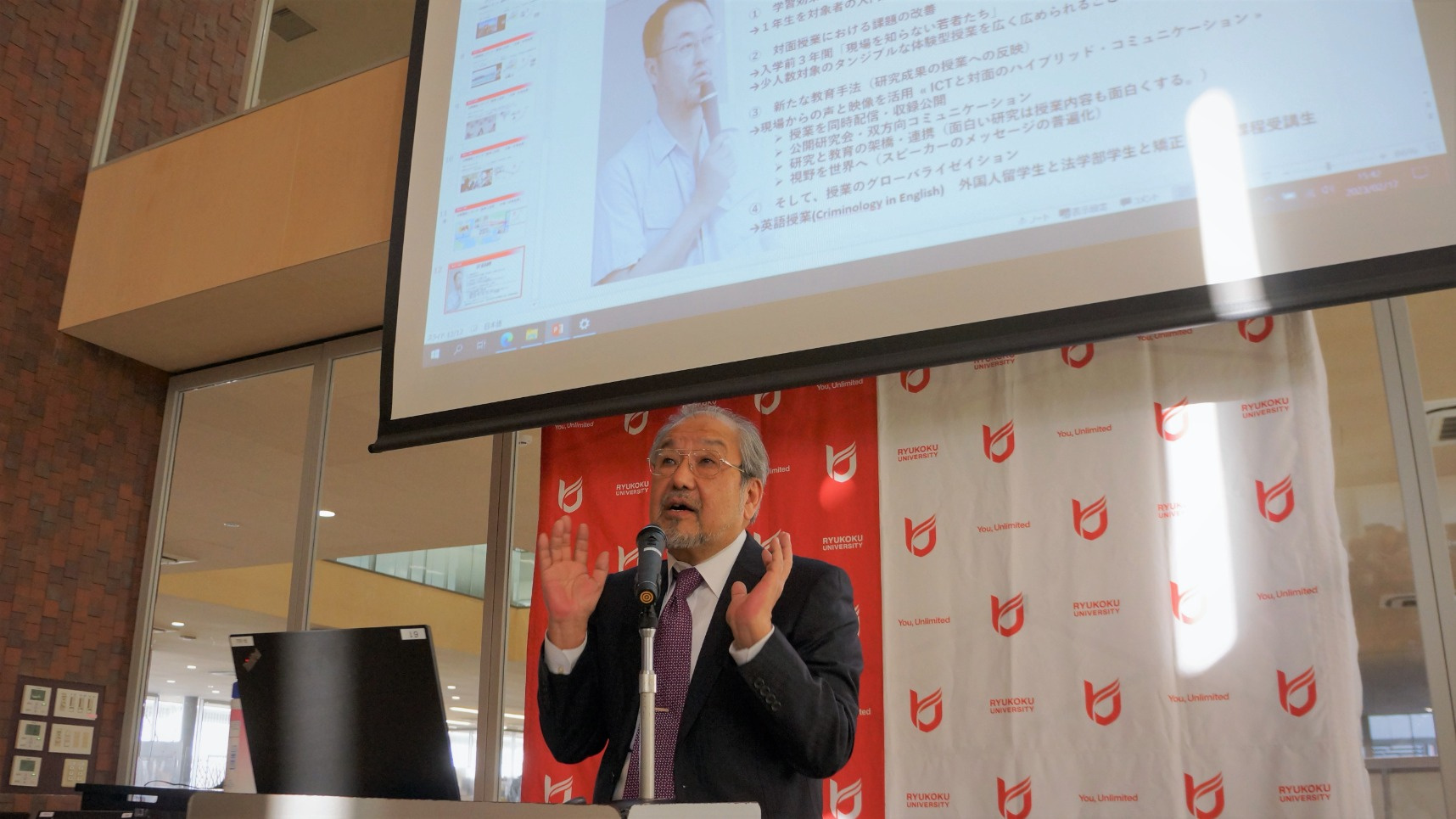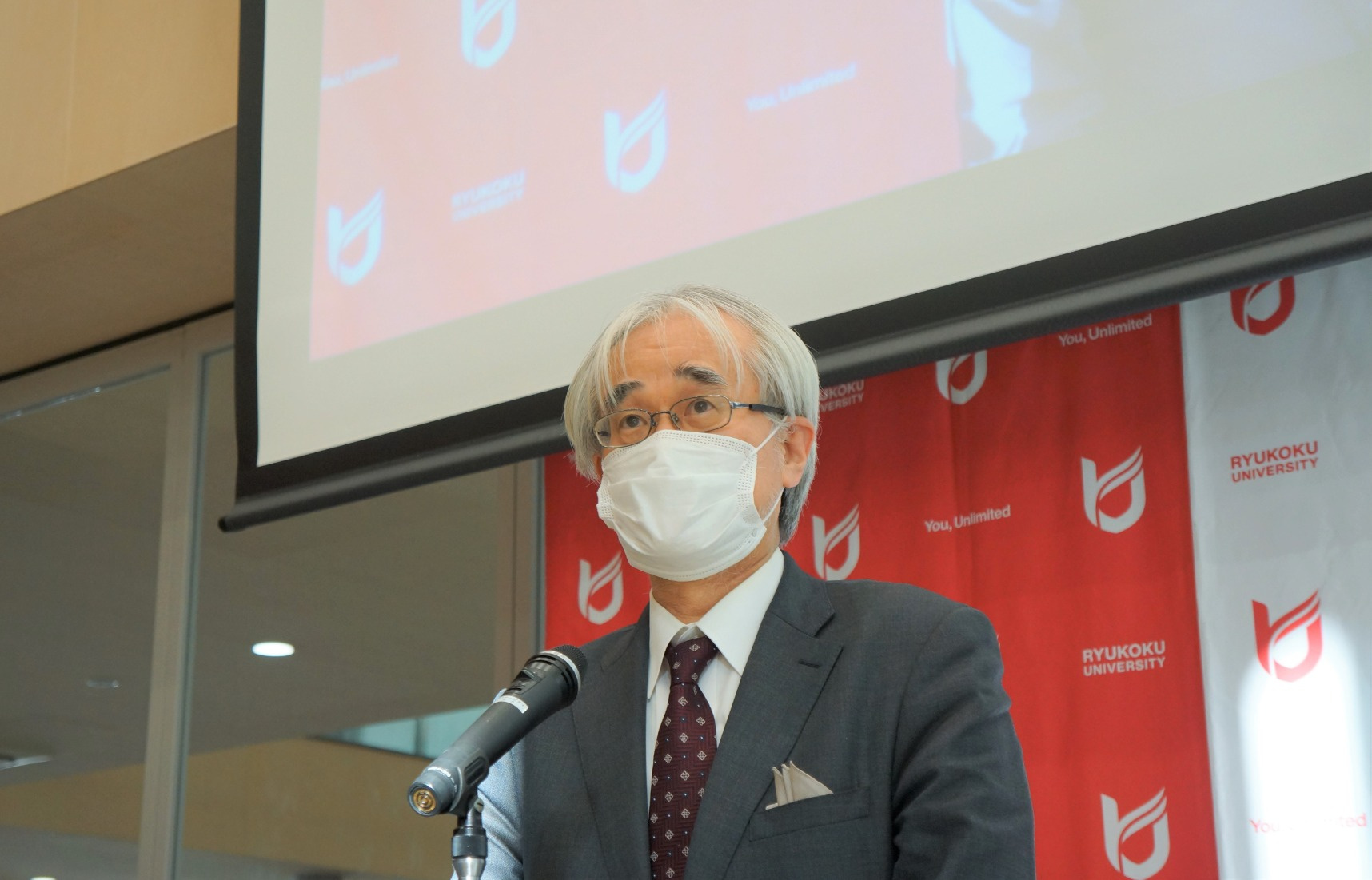
Photograph: Professor Shinichi Ishizuka (far left)
208th (Ordinary) Session of the Diet: House of Councillors Committee on Judicial Affairs (as held on June 7)
Professor Shinichi Ishizuka (Faculty of Law, Ryukoku University) attended the 208th (Ordinary) Session of the Diet: House of Councillors Committee on Judicial Affairs held on June 7, 2022, as an advisor.
The “Bill to Partially Amend the Penal Code (Cabinet Bill No. 57)” submitted to the 208th Session of the Diet proposed an increase in the statutory penalty for defamation, but also proposed to eliminate Imprisonment with Work, Imprisonment without Work, and Misdemeanor Imprisonment without Work from the punishment categories prescribed in the Penal Code, and consolidate these punishments into the newly established category of Koukinkei (consolidation into Imprisonment with Work).
Passage of the Bill would represent a major amendment that fundamentally changes the penal system of a Penal Code enacted in 1907. This change is anticipated to have a major impact not only on the debate over punishment by curtailment of freedom (imprisonment) that has unfolded to date but also on correctional practice.
Professor Ishizuka and other researchers deeply concerned with the situation called on interested parties and, in May 2022, submitted a “statement of opinion calling for serious and careful deliberation in the Diet and the raising of national debate” to the members of the House of Representatives Committee on Judicial Affairs.
The following is a summary of the statement of opinion by Professor Ishizuka.
───────────────────
■ Criminal Policy
Since the Meiji era, Japan’s criminal policy has been based on the principle of treating people who commit crimes with compassion while upholding a moral way of life. Munemitsu Mutsu (1844-1897) proposed the reprinting of Mukeiroku, a work by Tozan Ashino (1696-1776), a Confucian scholar of the late Edo period, that became an important resource for criminal policy in Japan. In Mukeiroku, Tozan Ashino proposes to “punish with a view to punish no more.” That is, punishment should not be an end in and of itself; rather, the ultimate goal of a penal system is the end of punishment. Many different processes have been established based on this belief. However, it has also given rise to some major mistakes. In the prewar period, referring to the “reform through labor laws” instituted by Nazi Germany, the idea spread that improving people through labor was an excellent idea, and that crime would stop if Japan also consolidated all punishments into Imprisonment with Work and reformed people through labor .” This way of thinking was abandoned after the war. The goal of labor is not to reformed people; rather, labor is simply one of many ways in which people achieve self-realization.
■ Impact of International Rules
The United Nations Standard Minimum Rules for the Treatment of Prisoners were referenced during debates on the revision of Prison Law and Penal Code in Japan around 1970 and were very influential. A UN Congress on Crime Prevention and Criminal Justice was held in Kyoto around 50 years ago. At the same time, Japan assumed full administrative control over the United Nations Asia and Far East Institute for the Prevention of Crime and the Treatment of Offenders (UNAFEI) and, to bring about reforms in line with the United Nations Standard Minimum Rules for the Treatment of Prisoners, took a leadership role in efforts to improve its correctional faculties along with those of neighboring Asian countries. In 2021, the UN Congress on Crime Prevention and Criminal Justice was once again held in Kyoto. However, the Japanese Ministry of Justice did not mention Koukinkei (consolidation into Imprisonment with Work) even once at this congress. Why the omission? It was omitted presumably because Koukinkei (consolidated Imprisonment with Work) goes against the current global outlook on correction.
■ Purpose of this Statement of Opinion
Article 12, paragraph 3 of the amending bill states, “a person who has been sentenced to Koukinkei (consolidation into Imprisonment with Work) may be made to engage in work or may be given guidance necessary for ensuring reformation and rehabilitation.” Who is the subject of this Article? Not many normal citizens could understand this Article in a single reading. The subject of this Article is not “the person who has been sentenced to Koukinkei (consolidation into Imprisonment with Work)” but “the warden of the penal institution.” That is, the Article stipulates the warden may make people who are sentenced to Koukinkei (consolidation into Imprisonment with Work) engage in work or give them guidance necessary for ensuring reformation and rehabilitation. This provision, were it to be included in the Penal Code, would make for an extremely ugly Article in our opinion as criminal policy scholars. This statement of opinion urges for the serious and careful deliberation of this bill in the Diet. Typically, at either a meeting of the Criminal Law Society of Japan or another similar society, someone from the Ministry of Justice provides notice of planned amendments or the person who drafted the amendment will provide an explanation of the amendment. When the Prison Act was amended in 2006, Makoto Hayashi, the current prosecutor-general, briefed the subcommittee on the matter. But in this case, we first learned of the proposed amendment when it was submitted as a cabinet bill in March 2022. A brief explanation was given at a criminal policy session of the Criminal Law Society of Japan meeting in May 2022, but no explanation was provided by a representative from the Ministry of Justice. We strongly urge that this bill undergo careful deliberation and wish for time so that we may examine the bill.
■ Details of the Proposed Amendment
(1) This amendment may increase the severity of Imprisonment with Work. In Japan, criminals are not only isolated in prisons, but also forced to work to maintain order in prison. Adding purpose of improvement to this punishment would force the reformation of personality and to this punishment would create a more severe punishment.
(2) Imprisonment without Work and Misdemeanor Imprisonment without Work both only involve physical restraint and being committed to a penal institution. Neither requires work. We must take a moment to consider what these mean. In 1974, a document on amending the Penal Code, titled Draft for Penal Code Amendments, was created. This prompted a great deal of discussion, including over “consolidating together punishments that involve curtailment of freedom (imprisonment).” The eventual conclusion at the time was that Imprisonment without Work should remain separate from Imprisonment with Work. The reason for this was that it would be insulting to impose a punishment of Imprisonment with Work for political offenses. This begs the question, if someone like Munemitsu Mutsu is sentenced to Imprisonment with Work and held in prison, i.e., when punishment is imposed on a politician for taking action for the sake of Japan, is it acceptable to impose labor on that person or impose education for their improvement?
The nation of Japan is built on its Law, and the Penal Code is what will protect the foundations of Japan for years to come. The current Penal Code may be old as it was created in 1907, but it has protected Japan to this day. If the Penal Code is to be changed, this change should be based on a commensurate degree of fortitude and philosophy. The German jurist Julius Hermann von Kirchmann (1802-1884) once said that three rectifying words by the legislator made entire legal libraries completely useless. Despite our years of research and the numerous books we have written, everything said by me today and all the research undertaken by us as criminal policy scholars would be completely useless if Diet members were to pass this bill. We sincerely urge careful deliberation of this bill.
───────────────────
• Please refer to PDF for the document distributed by Professor Shinichi Ishizuka. (Only in Japanese)
At a plenary session of the House of Councillors held on June 13, 2021, a Penal Code Amendment establishing Koukinkei (consolidation into Imprisonment with Work) consolidating the punishments “Imprisonment with Work” and “Imprisonment without Work” was passed and enacted by a show of hands with a majority of votes in favor.