Need Help?

新着情報

新着情報の一覧

製品情報

ここにメッセージを入れることができます。

 
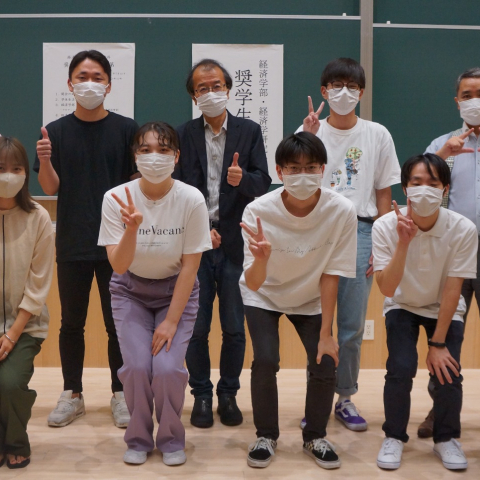
 経済学部国際経済学科の神谷ゼミ3年生(30名)は、2022年7月以降、彦根市にて「持続可能なまちづくり」をテーマとして、継続的にフィールドワークを行っています。

 彦根市では、2022年に忠田季空氏が開業したコミュニティカフェ「On Your Mark」を起点に、少人数のグループに分かれて、滋賀県立大学の学生さんとも一緒に、彦根市役所、複数の商店街、観光名所、子ども食堂、野菜などの直売所、農協を訪問し、実地調査を行いました。

 On Your Mark代表の忠田氏は、2018年4月に龍谷大学経済学部国際経済学科を卒業し、新卒で入社したまちづくりのコンサルティング会社に4年間に勤務した後、脱サラ・起業をした、新進気鋭のソーシャルアントレプレナーです。

 ゼミ生の中でも、特に藤崎将史さんと鍾頴徳さんが中心となり、継続的に「On Your Mark」と関わりを持ち、彦根市のまちづくりや商店街活性化の活動に関わっています。藤崎さんは、「忠田さんの活動は、現代の日本社会において非常に重要な取り組みであり、ぜひもっと多くの人に知ってもらいたい」と熱く語っています。

 忠田氏の活動は新聞記事にも広く取り上げられており、現在、今後の活動拡大のためにクラウドファンディングも行っています。

  <彦根にコミュニティーカフェ「オンユアマークカフェ」 学生が集える場に>
   https://hikone.keizai.biz/headline/78/

  <地域の子どもに学びの場所を!学生と共に創る彦根城下町コミュニティカフェ開設大作戦>
   https://camp-fire.jp/projects/view/626628?list=coming_soon

 龍谷大学経済学部ではSDGsの理念を大事にして、こうした地域に根ざした在学生や卒業生の主体的な活動を応援していきます。


クルドファンディングのご案内


犯罪学研究センターの兼任研究員である札埜和男准教授(龍谷大学文学部)が、法教育・法情報ユニットの活動として、2023年3月19日(日)、東京・飯田橋において高校生が対抗する模擬裁判イベント「高校生 文学模擬裁判 日本一決定戦」を実施します。傍聴人(観覧者)をひろく募集しています。ぜひふるってご参加ください。

【>>お申込みフォーム(Googleフォーム)】
傍聴定員:60名 ※お申し込み先着順・申込期限:3月17日(金)17:00


高校生「文学模擬裁判」日本一決定戦 in Tokyo

日時:2023年3月19日(日) 10:30-17:20(終了予定)
会場:(株)TKC東京本社内 模擬法廷 【→MAP】
   〒162-8585東京都新宿区揚場町2-1 軽子坂MNビル2F
  (最寄り駅:JR・地下鉄各線「飯田橋」駅)
出場校(アルファベット順):
 ・中央大学杉並高等学校(東京)
 ・神戸女学院高等学部(兵庫)


■概要:
 龍谷大学文学部・札埜研究室は、(一社)刑事司法未来龍谷大学 犯罪学研究センター法教育・法情報ユニット)と共に、2023年3月19日(日)、 東京・飯田橋において高校生が対抗する模擬裁判イベント「高校生 文学模擬裁判 日本一決定戦」を実施します。
 今回の参加校は、夏の「第2回オンライン高校生模擬裁判交流戦」優勝校・神戸女学院高等学部と、冬の「第3回オンライン高校生模擬裁判選手権」優勝校・中央大学杉並高等学校の2校であり、両校の直接対決となります。大会当日は、参加校が検察側・弁護側に分かれて立証・弁護活動を展開します。審査員は、それらの内容を読解力、人間や社会への洞察力、論理性、表現力等の視点から評価し、勝敗を決します。
 本大会の様子は、どなたでも申込制で“傍聴”することが可能です。成人年齢の18歳への引き下げに伴い、裁判員裁判への高校生の参加が早ければ今年にも実現します。こうした状況下で、若い世代の司法参加を見据えた法教育の在り方に一石を投じるイベントです。

■題材:
今回の教材は、古典落語「河豚鍋」を主なモチーフにして作成しました。
原話が作られた時代は、一般庶民でも河豚が入手しやすいものの、現代のようにふぐ調理師の免許制度がなく、河豚の毒による死亡事故が後を絶たなかったと伝わります。シナリオの起訴状に記載された罪名は「殺人罪」。検察官は河豚鍋を使用人に勧めたとされる商家の主の殺人罪を主張し、弁護人は被害者である使用人が河豚鍋を自らの意思で食したことで死亡したのであり、殺人罪でないことを主張。高校生らは、罪に問われた商家の主の行為をどのように立証、弁護していくのでしょうか。
なお、これまでの文学模擬裁判で扱った作品は、森鴎外「高瀬舟」、芥川龍之介「羅生門」・「藪の中」、新美南吉「ごん狐」があります。

■本大会のねらい:
(1)法的思考力や刑事(裁判員)裁判の意義の理解にとどまらず、広く人間や社会までを視野に入れた「国語的」模擬裁判を通じて、人間や社会を考える眼差しを深める。
(2)「文学模擬裁判」という教科横断的な新しいメソッドの普及を図り、日本の刑事司法の未来を支える担い手を育成することや、日本の教育の質向上に寄与する。
(3)模擬裁判に関わる高校生同志の交流を図る。

■競技方法:
参加校は、予め配布される文学教材や関連資料をもとに、検察側・弁護側それぞれの立場に立って立証・弁護活動を行う。シナリオ創作型の模擬裁判である。
参加校は決められた時間に従い立証・弁護活動を行い、検察側・弁護側両方の立場で模擬裁判を行うことになる(午前中の試合で検察側を担当したチームは、午後弁護側を担当する。逆に、午前中の試合で弁護側を担当したチームは、午後弁護側を担当する)。優勝校を決定し、MVPを選ぶ。

■当日のスケジュール:
10時30分  第1試合開始
12時30分頃 第1試合終了
 (昼休憩)
13時30分 第2試合開始
15時30分頃 第2試合終了  
16時10分  成績発表、表彰式、講評、振り返り交流会
17時20分頃 終了

■問い合わせ
〒600‐8268 京都市下京区七条通大宮東入大工町125‐1
龍谷大学大宮キャンパス 西黌129号室
札埜研究室 宛  TEL 075‐343‐3326(研究室直通)
E-mail: fudafuda@let.ryukoku.ac.jp

主催:(一社)刑事司法未来龍谷大学犯罪学研究センター・龍谷大学札埜研究室
後援:龍谷大学矯正・保護総合センター・龍谷大学法情報研究会・京都教育大学附属高等学校模擬裁判同窓会・現代人文社株式会社TKC刑事弁護OASIS

※本企画はJSPS科研費(課題番号「20K02809」)「国語科の視点を取り入れた新科目『公共』で活用可能な模擬裁判メソッドの研究開発」基盤研究(C)(一般)の助成を受けています。


ファイルを開く

高校生「文学模擬裁判」日本一決定戦_フライヤー


ファイルを開く

高校生「文学模擬裁判」日本一決定戦_実施要項


龍谷大学発酵醸造微生物リソース研究センターでは、3月10日(金)午後1時30分より
オンラインにてシンポジウムを開催します。
ご関心のある方は、ぜひご参加ください。

-----------------------------------------------------------------
<概要>

【日時】 2023年3月10日(金)13:30~15:50 
【開催形態】Zoomによるオンライン(事前申込制・参加費無料)

【プログラム】
13:30-14:00 挨拶と研究紹介
                 「フナズシ乳酸発酵における優占種について」
        田邊公一(龍谷大学農学部・教授/
                                         発酵醸造微生物リソース研究センター・センター長)
                       島 純 (龍谷大学農学部・教授/
                                          発酵醸造微生物リソース研究センター・副センター長)

14:00-14:30 「緑肥圃場で線虫群のふるまいを捉える試み」
                        浅水恵理香(龍谷大学農学部・教授/
                                              発酵醸造微生物リソース研究センター・研究員)

14:30-14:40    休憩

14:40-15:40 「環境DNAで探る菌類の多様性」
        松岡俊将 氏(京都大学フィールド科学教育研究センター)

15:40-15:50    閉会の挨拶

【申し込み先】発酵醸造微生物リソース研究センター事務局
                  以下のメールアドレスに、件名を「参加申し込み」として、本文に
                (1)氏名(2)所属(3)返信用のメールアドレスを記入してお送り
       ください。
                 シンポジウム前日までにZoom URLと資料をメールでお送りします。
          申し込み先:hakko-rc@ad.ryukoku.ac.jp

【申し込み締切】3月7日(火)

【主催】龍谷大学発酵醸造微生物リソース研究センター

【問い合わせ先】発行醸造微生物リソース研究センター事務局 担当:中平
        E-mail:hakko-rc@ad.ryukoku.ac.jp

皆さまのご参加をお待ち申し上げております。


Photograph: Professor Shinichi Ishizuka (far left)

Photograph: Professor Shinichi Ishizuka (far left)


208th (Ordinary) Session of the Diet: House of Councillors Committee on Judicial Affairs (as held on June 7)

208th (Ordinary) Session of the Diet: House of Councillors Committee on Judicial Affairs (as held on June 7)

Professor Shinichi Ishizuka (Faculty of Law, Ryukoku University) attended the 208th (Ordinary) Session of the Diet: House of Councillors Committee on Judicial Affairs held on June 7, 2022, as an advisor.

The “Bill to Partially Amend the Penal Code (Cabinet Bill No. 57)” submitted to the 208th Session of the Diet proposed an increase in the statutory penalty for defamation, but also proposed to eliminate Imprisonment with Work, Imprisonment without Work, and Misdemeanor Imprisonment without Work from the punishment categories prescribed in the Penal Code, and consolidate these punishments into the newly established category of Koukinkei (consolidation into Imprisonment with Work).

Passage of the Bill would represent a major amendment that fundamentally changes the penal system of a Penal Code enacted in 1907. This change is anticipated to have a major impact not only on the debate over punishment by curtailment of freedom (imprisonment) that has unfolded to date but also on correctional practice.
Professor Ishizuka and other researchers deeply concerned with the situation called on interested parties and, in May 2022, submitted a “statement of opinion calling for serious and careful deliberation in the Diet and the raising of national debate” to the members of the House of Representatives Committee on Judicial Affairs.

The following is a summary of the statement of opinion by Professor Ishizuka.
───────────────────
■ Criminal Policy
Since the Meiji era, Japan’s criminal policy has been based on the principle of treating people who commit crimes with compassion while upholding a moral way of life. Munemitsu Mutsu (1844-1897) proposed the reprinting of Mukeiroku, a work by Tozan Ashino (1696-1776), a Confucian scholar of the late Edo period, that became an important resource for criminal policy in Japan. In Mukeiroku, Tozan Ashino proposes to “punish with a view to punish no more.” That is, punishment should not be an end in and of itself; rather, the ultimate goal of a penal system is the end of punishment. Many different processes have been established based on this belief. However, it has also given rise to some major mistakes. In the prewar period, referring to the “reform through labor laws” instituted by Nazi Germany, the idea spread that improving people through labor was an excellent idea, and that crime would stop if Japan also consolidated all punishments into Imprisonment with Work and reformed people through labor .” This way of thinking was abandoned after the war. The goal of labor is not to reformed  people; rather, labor is simply one of many ways in which people achieve self-realization.

■ Impact of International Rules
The United Nations Standard Minimum Rules for the Treatment of Prisoners were referenced during debates on the revision of Prison Law and Penal Code in Japan around 1970 and were very influential. A UN Congress on Crime Prevention and Criminal Justice was held in Kyoto around 50 years ago. At the same time, Japan assumed full administrative control over the United Nations Asia and Far East Institute for the Prevention of Crime and the Treatment of Offenders (UNAFEI) and, to bring about reforms in line with the United Nations Standard Minimum Rules for the Treatment of Prisoners, took a leadership role in efforts to improve its correctional faculties along with those of neighboring Asian countries. In 2021, the UN Congress on Crime Prevention and Criminal Justice was once again held in Kyoto. However, the Japanese Ministry of Justice did not mention Koukinkei (consolidation into Imprisonment with Work) even once at this congress. Why the omission? It was omitted presumably because Koukinkei (consolidated Imprisonment with Work) goes against the current global outlook on correction.

■ Purpose of this Statement of Opinion
Article 12, paragraph 3 of the amending bill states, “a person who has been sentenced to Koukinkei (consolidation into Imprisonment with Work) may be made to engage in work or may be given guidance necessary for ensuring reformation and rehabilitation.” Who is the subject of this Article? Not many normal citizens could understand this Article in a single reading. The subject of this Article is not “the person who has been sentenced to Koukinkei (consolidation into Imprisonment with Work)” but “the warden of the penal institution.” That is, the Article stipulates the warden may make people who are sentenced to Koukinkei (consolidation into Imprisonment with Work) engage in work or give them guidance necessary for ensuring reformation and rehabilitation. This provision, were it to be included in the Penal Code, would make for an extremely ugly Article in our opinion as criminal policy scholars. This statement of opinion urges for the serious and careful deliberation of this bill in the Diet. Typically, at either a meeting of the Criminal Law Society of Japan or another similar society, someone from the Ministry of Justice provides notice of planned amendments or the person who drafted the amendment will provide an explanation of the amendment. When the Prison Act was amended in 2006, Makoto Hayashi, the current prosecutor-general, briefed the subcommittee on the matter. But in this case, we first learned of the proposed amendment when it was submitted as a cabinet bill in March 2022. A brief explanation was given at a criminal policy session of the Criminal Law Society of Japan meeting in May 2022, but no explanation was provided by a representative from the Ministry of Justice. We strongly urge that this bill undergo careful deliberation and wish for time so that we may examine the bill.

■ Details of the Proposed Amendment
(1) This amendment may increase the severity of Imprisonment with Work. In Japan, criminals are not only isolated in prisons, but also forced to work to maintain order in prison. Adding purpose of improvement to this punishment would force the reformation of personality and to this punishment would create a more severe punishment.
(2) Imprisonment without Work and Misdemeanor Imprisonment without Work both only involve physical restraint and being committed to a penal institution. Neither requires work. We must take a moment to consider what these mean. In 1974, a document on amending the Penal Code, titled Draft for Penal Code Amendments, was created. This prompted a great deal of discussion, including over “consolidating together punishments that involve curtailment of freedom (imprisonment).” The eventual conclusion at the time was that Imprisonment without Work should remain separate from Imprisonment with Work. The reason for this was that it would be insulting to impose a punishment of Imprisonment with Work for political offenses. This begs the question, if someone like Munemitsu Mutsu is sentenced to Imprisonment with Work and held in prison, i.e., when punishment is imposed on a politician for taking action for the sake of Japan, is it acceptable to impose labor on that person or impose education for their improvement?
The nation of Japan is built on its Law, and the Penal Code is what will protect the foundations of Japan for years to come. The current Penal Code may be old as it was created in 1907, but it has protected Japan to this day. If the Penal Code is to be changed, this change should be based on a commensurate degree of fortitude and philosophy. The German jurist Julius Hermann von Kirchmann (1802-1884) once said that three rectifying words by the legislator made entire legal libraries completely useless. Despite our years of research and the numerous books we have written, everything said by me today and all the research undertaken by us as criminal policy scholars would be completely useless if Diet members were to pass this bill. We sincerely urge careful deliberation of this bill.
───────────────────

• Please refer to PDF for the document distributed by Professor Shinichi Ishizuka. (Only in Japanese)

At a plenary session of the House of Councillors held on June 13, 2021, a Penal Code Amendment establishing Koukinkei (consolidation into Imprisonment with Work) consolidating the punishments “Imprisonment with Work” and “Imprisonment without Work” was passed and enacted by a show of hands with a majority of votes in favor.


学部連合学生会の学生コメントの様子

2月17日、2022年度「龍谷ICT教育 学長賞」公開審査会を開催しました。

3年目となる今年度は、組織的取組3件の取組が「龍谷ICT教育賞」として選出されました。

 ・インターンシップ支援オフィス
 ・犯罪学研究センター
 ・障がい学生支援室

本審査会では各取組がプレゼンテーションを行い、「龍谷ICT教育 学長賞」を決めるための審査を行いました。
また、ICTを活用した教育効果の向上をはかる実践的な取組を共有する機会にもなることから、対面及びオンラインのハイブリッド形式で実施しました。

審査委員として、入澤学長、FD・教学IR企画推進委員会委員の先生方、学部連合学生会(Twitterアカウント→ @kengakunoseisin)の学生が参加し、各取組の発表後に、学生からコメントがありました。学生目線でありながら、しっかりとしたコメントをいただきました。そのほか、発表者同士でも質疑応答が行われ、活発な意見交換がなされました。


発表の様子(インターンシップ支援オフィス)


発表の様子(犯罪学研究センター)


質問に答える様子(障がい学生支援室)


学部連合学生会の学生コメントの様子


入澤学長 挨拶


司会進行:藤田学修支援・教育開発センター長

審査結果は、3月中旬に公表予定です。また、今回応募のあった取組については、あらためてWebページにて共有する予定です。引き続き、ご注目ください。


a

龍谷大学 You, Unlimitedの記事一覧

お電話でのお問い合せはこちら

電話番号: